
A roundup of the AUD to USD forecast 2027 and what the big banks reckon is coming, plus how the Aussie Dollar performed against the greenback in FY2026.
The USA is calling. Maybe it's a Colorado road trip, a Disney World adventure with the kids, a white Christmas in New York… or a Vegas weekend you've told absolutely no one about (no judgement here). Whatever the plan, there's one number standing between you and your holiday budget: the Australian Dollar to United States Dollar (AUD to USD) exchange rate.
Here's the thing: unlike the Vietnamese Dong or the Indonesian Rupiah, the AUD to USD rate is thankfully simple to read. It's just a number under one dollar, usually something like US$0.70. No counting zeros, no five-digit headaches. But that simplicity can hide a lot of drama, because the Australian Dollar is one of the most fluctuating currencies on the planet.
To put it in real money: exchange AUD$2,000 when the rate is US$0.66 and you'll bank around US$1,320. Wait for it to climb to US$0.73 and the same AUD$2,000 hands you US$1,460. That's an extra US$140* for doing nothing but timing it better — roughly a night in a mid-range US hotel, or nine big diner breakfasts, or a theme-park day pass with churros to spare. Not bad, hey?
So, let's break down where the Aussie Dollar has been over FY2026, and where Australia's big banks think it's heading in FY2027. We promise to keep it simple.
First, a quick FY refresher…
When we say FY 2026, we mean the Australian financial year that runs 1 July 2025 to 30 June 2026. FY 2027 is 1 July 2026 to 30 June 2027. So put the calendar year aside just for a moment.
How did the AUD to USD rate perform in FY2026?
TL;DR: FY2026 was a comeback year for the Aussie. It started soft, had a wobble, then found itself towards the end.
Where it started (July 2025): The Aussie opened the financial year hovering around US$0.65. Respectable, but nothing to write home about.
The soft patch (late 2025): Through the back half of 2025 the AUD drifted, dipping to a low of around US$0.66 in mid-December 2025. Markets were nervous about Chinese demand for iron ore (Australia's biggest export earner) and the US Dollar was holding firm.
The climb (early–mid 2026): This is where it got interesting. Australian inflation came back hotter than anyone wanted, and the Reserve Bank of Australia did something it hadn't done in a while — it raised the cash rate, taking it to 4.35% in May 2026 (with more hikes flagged). Yep, anyone with a mortgage will remember the sting.
A Middle East flare-up that pushed oil prices sharply higher added to the inflation. Meanwhile the US Federal Reserve sat on its hands, so the gap between Aussie and US interest rates widened in the AUD's favour. Higher Aussie rates make the dollar more attractive to global investors, and the Aussie took off, peaking at around US$0.726 in mid-May 2026 — its strongest level in about three years.
Where it landed (June 2026): After that run, the Aussie cooled off and settled back to around US$0.70 by mid-June 2026.
The FY2026 scorecard: From roughly US$0.65 to around US$0.70 — a gain of about 7–8% across the financial year, with a cheeky peak above 72 US cents in between. If you bought your US Dollars in May, give yourself a high five.
What is the AUD to USD forecast for FY2027?
So, the Aussie has had a big year. The question every traveller, expat and FX watcher is now asking, what is the AUD to USD forecast 2027? Through 2026, as the RBA kept hiking and the Middle East energy shock lingered, most banks revised their forecasts upward — so the major bank views now cluster around US$0.70 to US$0.75 across FY2027 (July 2026 to June 2027), with ING the most positive.
A heads-up before you read: forecasters disagree. A lot. That's normal, and it's exactly why you should never bet your whole travel fund on a single prediction. Read a few, find the middle, and plan around that. The figures below are each bank's most recently published view — and in a fast-moving year they get revised often, so we've linked each one so you can check the latest.
| Bank/Institution | FY2027 view (AUD to USD) | Vibe |
| ING | Upgraded to approx. 0.74–0.75 by end-2026 | Most positive |
| CBA (CommBank) | Approx. 0.70–0.73, with room toward 0.73 | Positive |
| Westpac | Approx. 0.71–0.73 | Positive |
| NAB | Peak approx. 0.72 around Q3 2026, easing to approx. 0.71 | Positive |
| MUFG | Approx. 0.70 | Moderate |
Table: Figures reflect each bank's most recent publicly available outlook. Westpac, NAB and CBA are Australia's major banks; ING and MUFG are global investment banks, included as an international cross-check. In a fast-moving year these get revised often, so each name links to its research page if you want the latest.
What this means in plain English
The typical big-bank view for FY2027 now sits in the US$0.70 to US$0.75 range — stronger than where the Aussie ended FY2026. The common thread among the optimists is the expectation that Australian interest rates will stay higher than US rates for longer, which tends to support the dollar. ING made the biggest move: it upgraded its end-2026 target to around US$0.75, citing a hawkish RBA and the lingering energy-price shock. MUFG sits at the cautious end, closer to US$0.70.
So, what's it worth to you?
Let's run AUD$2,000 through the range so you can see it in holiday terms.
That spread between the gloomy and the rosy scenario is up to US$180 on AUD$2,000 — call it a couple of nights' accommodation, a nice dinner for the family, or a tank of petrol plus a stack of In-N-Out runs on your road trip.
| If the rate is… | A$2,000 gets you… | Difference vs 0.70 |
| US$0.66 (if it slips to FY2026 lows) | US$1,320 | US$80 less |
| US$0.70 (around today) | US$1,400 | — |
| US$0.73 (upper end of forecasts) | US$1,460 | US$60 more |
| US$0.75 (ING's end-2026 call) | US$1,500 | US$100 more |
A quick heads-up: these conversions use the mid-market rate — the midpoint rate quoted by banks and data providers. It's not the retail rate you'll actually get when you buy your travel money, which includes a margin. Treat these figures as a guide to how the market moves, not an exact quote.
How do the banks come up with these numbers?
Banks crunch a huge amount of data, and no single method is bulletproof — which is why even the experts land all over the map. But you don't need an economics degree to follow the logic. It really comes down to a handful of forces. Here are the big ones, traveller-style.
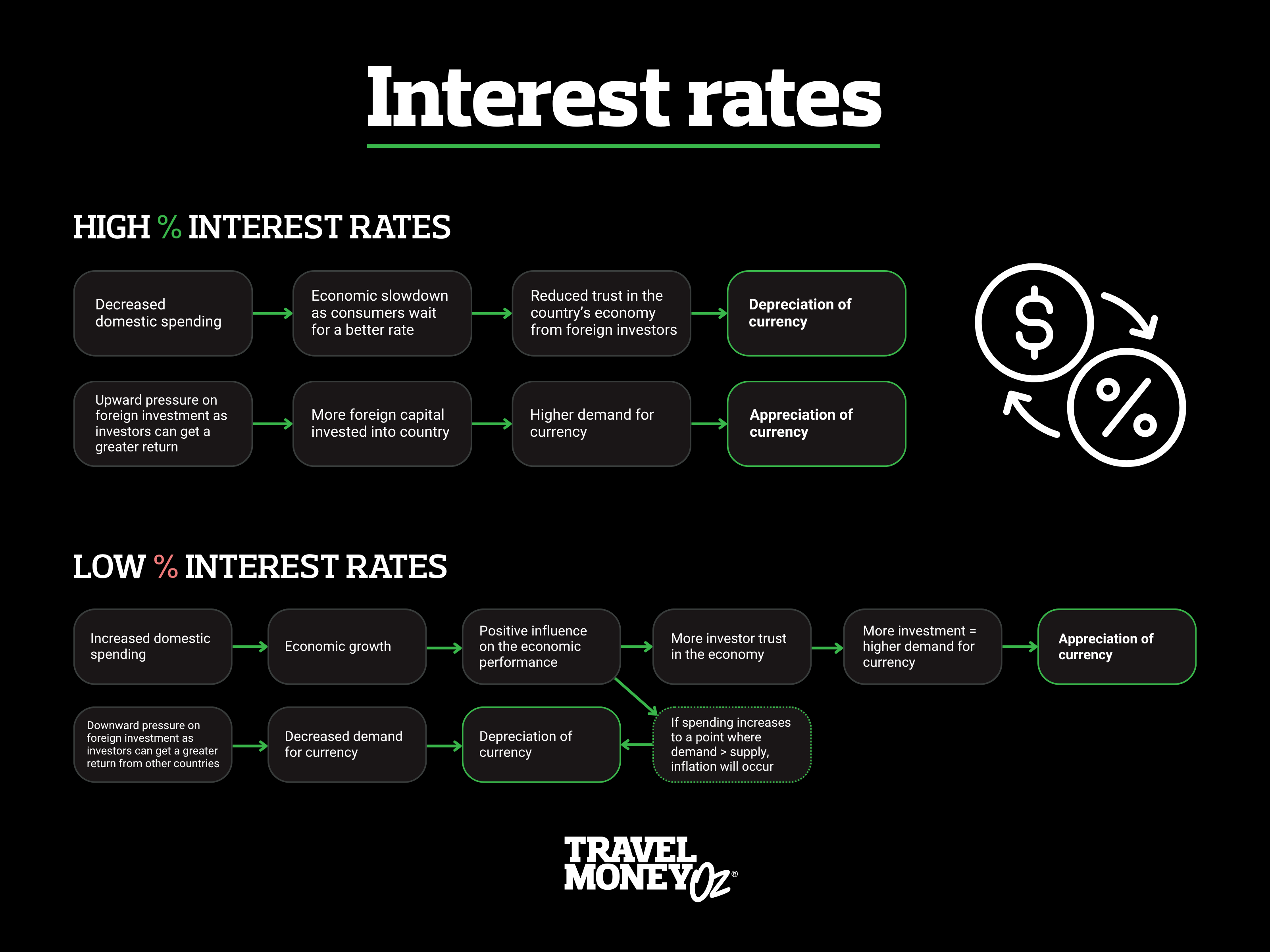
Interest rates (the big one): When Australian interest rates are higher than US rates, global money flows toward Aussie assets to chase the better return, and that demand pushes the AUD up. This was the story of FY2026 — the RBA hiking to 4.35% while the Fed stayed put gave the Aussie its wings.
Commodity prices: Australia digs up and ships out a lot of iron ore, coal, gas and gold. When global demand for those is strong (especially from China), more buyers need Aussie Dollars to pay for them — and up goes the AUD. Weak Chinese demand does the opposite.
Risk sentiment: The Australian Dollar is what traders call a "risk-on" currency. When the world feels confident, money flows into the AUD. When everyone's spooked — wars, market crashes, general doom — money runs to the safe-haven US Dollar instead, and the Aussie Dollar sinks.
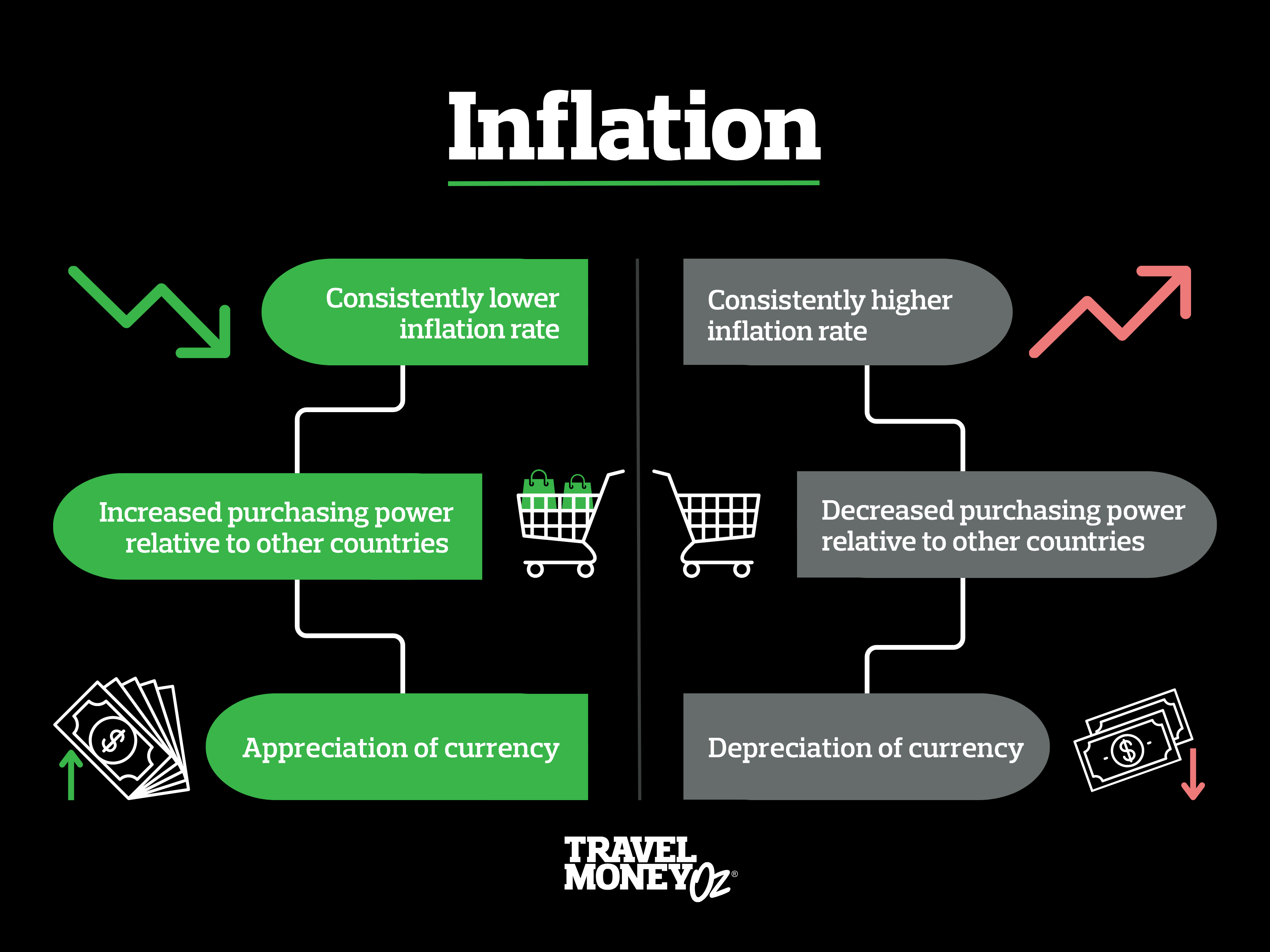
Inflation: If prices are rising too fast at home, the RBA tends to lift interest rates to cool things down (see FY2026), which can support the currency. It's all connected, see?
A few definitions to sound clever at trivia
Appreciation: when the Aussie gains value. E.g. AUD going from US$0.70 to US$0.73 means it has appreciated — and you'll appreciate the extra burgers.
Depreciation: when the Aussie loses value. AUD going from US$0.73 to US$0.70. Fewer burgers, more budgeting.
A higher Aussie Dollar means cheaper imports, more expensive exports, and more US Dollars in your travel wallet. A lower Aussie Dollar means the reverse — and a tighter holiday.
The golden rule: a currency's value is really just supply and demand.
- More trust = more people willing to invest in country = greater demand for currency = appreciation
- Less trust = less foreign capital invested into country = decreased demand for currency = depreciation
The traveller's takeaway
From where we sit in mid-2026, the big banks lean optimistic on the Aussie Dollar for FY2027 — most see it holding in the US$0.70–0.75 zone, with ING the cheerleader tipping as high as 0.75 by the end of 2026 and MUFG the most cautious at around 0.70.
What does that mean for your trip? If the optimists are right, holding off a touch in FY2027 could stretch your US Dollars further. But forecasts are educated guesses, not guarantees — the RBA, the Fed, China and global drama can all flip the script overnight.
It's important to keep in mind these are just predictions, and rates can fluctuate at the drop of a hat due to many factors, so it's best to lock in your rate as soon as it's favourable. You can do that with our Rate Move Protection, if the rate improves within 7 days of buying, we'll give you the difference*.
Now go forth and budget those churros.
Disclaimer:
*This blog is provided for information only and does not take into consideration your objectives, financial situation or needs. The forecasts referenced here are based on publicly available information published by major banks and financial institutions, and are predictions made by those third parties — they are subject to change and are not guarantees of future performance. All exchange rates, forecasts and conversion examples in this article refer to the mid-market rate (the midpoint between the buy and sell prices, as quoted by banks and financial data providers). This is not the retail rate you receive when you exchange currency. Like all currency providers, Travel Money Oz exchanges at retail rates, which include a margin, so the actual amount of US Dollars you receive for your Australian Dollars will differ from the mid-market figures shown here. You should consider whether the information and suggestions here are appropriate for you. Rates may vary across providers and over time. Figures and "what it buys you" examples are approximations and should be used as a guide only.
* Terms and conditions apply to Rate Move Protection; you can find them here.
FAQ
Will the Australian Dollar get stronger against the Vietnamese Dong in 2027?
What was the highest AUD to VND rate in FY2026?
When is the best time to buy Yen?
Tags
About the Author
.png?h=1080&iar=0&w=1920&t=m16x9)
Amber Dorman
More like this
