
How the Australian Dollar to Vietnamese Dong exchange rate performed in FY2026, and what Australia's banks (and one major regional cross-check) say about FY2027.
Vietnam has become one of the great value destinations for Aussie travellers — Hanoi's old quarter, Hoi An's lanterns, Ha Long Bay, a banh mi that costs less than your bus fare. All of it runs on the AUD to VND exchange rate, and it's currently doing travellers a lot of favours: 1 Australian Dollar buys around 18,200 Vietnamese Dong in mid-2026, comfortably among the stronger levels of the past year.
A quick note on reading the numbers, because the dong has more zeros than almost any currency you'll deal with. At today's rate, a ₫50,000 bowl of pho is only about A$2.75, and A$1,000 converts to roughly 18 million dong. It looks alarming on a bill, but once you get used to mentally dropping the last three zeros and thinking in thousands, it's genuinely easy to manage.
To put it in real money: convert A$2,000 at ₫18,200 and you'll bank about ₫36,400,000 — serious spending power for street food, day tours, hotel upgrades and everything else on a Vietnam trip. Drop the rate to ₫17,000 and that same A$2,000 only gets you ₫34,000,000 — about ₫2.4 million less, or roughly a couple of extra nights' accommodation gone.
So, let's look at how the Australian Dollar to Vietnamese Dong performed through FY2026, and what the banks are forecasting for FY2027.
First, a quick FY refresher…
When we say FY 2026, we mean the Australian financial year that runs 1 July 2025 to 30 June 2026. FY 2027 is 1 July 2026 to 30 June 2027. So put the calendar year aside just for a moment.
How did the AUD to USD rate perform in FY2026?
TL;DR: A strong year for the Aussie. AUD to VND climbed roughly 7–8% over the financial year and touched its highest level in years along the way.
Where it started (July 2025): The Aussie opened the financial year near its weakest point of the year, around ₫16,800–17,000.
The climb (through to May 2026): From there it climbed steadily as the RBA's rate hikes lifted the Australian Dollar broadly, while the dong faced its own pressures — a strong US Dollar, heavy import demand, and unofficial gold-related dollar buying that pushed Vietnam's central bank to intervene repeatedly to defend the currency. AUD to VND peaked at around ₫19,100–19,150 on 13 May 2026, its highest level in years.
Where it landed (mid-2026): It's eased back to around ₫18,100–18,300 by early July 2026.
The FY2026 scorecard: From roughly ₫16,900 to around ₫18,200 — up about 7–8% across the year, with a bigger intra-year swing of around 14% from the July low to the May high. Worth knowing: the dong was one of the weaker currencies in Asia for much of 2025, so the Aussie's gains here say as much about Vietnam's currency pressures as they do about Australian strength.
What is the AUD to USD forecast for FY2027?
Here's the key thing to understand: this rate comes down to a genuine tug-of-war, and unusually, the forecasters don't agree on which way the dong itself is heading.
MUFG has a real, published call, and it's currently the most useful one available: in its Vietnam research (December 2025), MUFG expects the dong to keep weakening a little further over 2026, rather than recover.
Here's how that stacks up against Australia's own banks:
| Bank/Institution | View on the dong | Implied AUD to VND, FY2027* |
| MUFG | Dong weakens further over 2026 | Higher, ~₫18,750–19,550 |
| Westpac | No Vietnam-specific call; its broader Asia FX view expects regional currencies to gain against the US Dollar over a two-year horizon | Directionally lower (if applied to the dong) |
| NAB | No specific dong target published; house view leans toward RBA rate cuts by 2027, trimming some Aussie support | Directionally lower still, no firm figure |
How we get there: MUFG doesn't publish a direct AUD to VND figure — like most banks, it forecasts the dong against the US Dollar, which it sees easing toward 26,800 per US Dollar through 2026. Combining that with an Australian Dollar sitting around US$0.70–0.73 (roughly the major banks' broad FY2027 range) gives the implied AUD to VND range shown above. Westpac's Vietnam view is inferred from its general commentary on Asian currencies broadly strengthening against the US Dollar over time — it doesn't name the dong specifically, so treat that row as a directional read rather than a forecast. NAB covers currency markets in its Global FX Strategist but doesn't publish a specific target for the dong on its public site. These are point-in-time views that get revised, so follow the links for the latest.
What this means in plain English
MUFG's dated, Vietnam-specific research thinks the dong has further to weaken (which would push AUD to VND higher, good news for travellers), while the general tone from banks like Westpac on Asian currencies overall points the other way (a recovering dong, which would ease AUD to VND back down).
The practical read: the rate could plausibly sit anywhere from the high ₫17,000s to the high ₫18,000s or beyond over FY2027, depending on which force wins out — Vietnam's own currency pressures (gold-market dollar demand, import growth, a managed float that tolerates gradual depreciation) versus a broader global drift away from the US Dollar.
So, what's it worth to you?
Let's run AUD$2,000 through the range so you can see it in holiday terms.
The honest takeaway: the Aussie is already sitting well compared with a year ago, and the most specific, dated forecast available (MUFG's) points to further room to run rather than a pullback — though it's genuinely a two-way bet given how the other commentary leans.
| If the rate is… | A$2,000 gets you… | Difference vs ₫18,200 |
| ₫17,000 (if the dong recovers) | ₫34,000,000 | ₫2,400,000 less |
| ₫18,200 (around today) | ₫36,400,000 | — |
| ₫19,000 (middle of MUFG's implied range) | ₫38,000,000 | ₫1,600,000 more |
| ₫19,500 (top of MUFG's implied range) | ₫39,000,000 | ₫2,600,000 more |
A quick heads-up: these conversions use the mid-market rate — the midpoint rate quoted by banks and data providers. It's not the retail rate you'll actually get when you buy your travel money, which includes a margin. Treat these figures as a guide to how the market moves, not an exact quote.
How do the banks come up with these numbers?
Banks and analysts crunch a mountain of data, and no method is bulletproof. For AUD/VND specifically, a few forces matter most.
On the Aussie side — interest rates: High Australian interest rates (the RBA's cash rate reached 4.35% through 2026) make the Australian Dollar attractive to hold, supporting it broadly, including against the dong.
On the dong side — the managed float: Vietnam's State Bank doesn't let the dong trade freely; it manages the currency within a band and steps in — selling US Dollars, adjusting rates, using FX swaps — to smooth out sharp moves. That means depreciation tends to happen gradually rather than in sudden shocks, but it also means the SBV's tolerance for further weakness is a genuine swing factor.
Gold and unofficial dollar demand: An unusual quirk of Vietnam's currency story is a persistent gap between local and global gold prices, which encourages unofficial gold imports paid for in US Dollars — adding extra demand for dollars (and pressure on the dong) outside normal trade flows.
Trade and foreign investment: Vietnam continues to draw strong foreign direct investment and posts trade surpluses, both long-term positives for the dong — but heavy import growth (machinery, components, energy) has recently outpaced this support.
A few definitions to sound clever at trivia
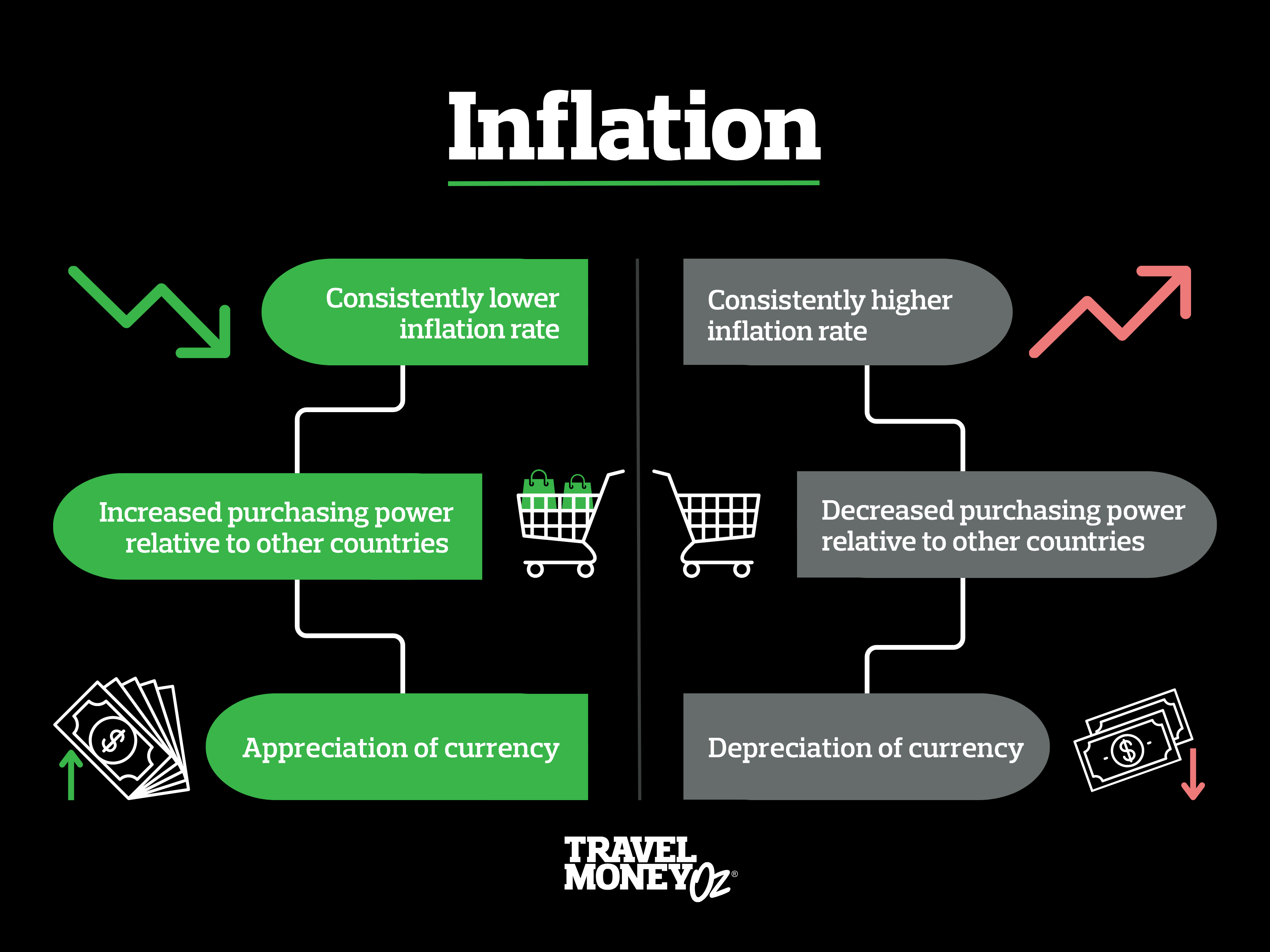
Appreciation: when the Aussie gains value. AUD to VND going from ₫17,500 to ₫18,200 means it has appreciated — more dong per dollar.
Depreciation: when the Aussie loses value. ₫18,200 back to ₫17,500. Fewer dong for your trip.
A higher AUD to VND rate means more dong for your holiday. A lower one means a tighter trip. And remember the cross-rate quirk: the rate can move simply because the dong is strengthening or weakening, even if the Aussie itself hasn't changed much.
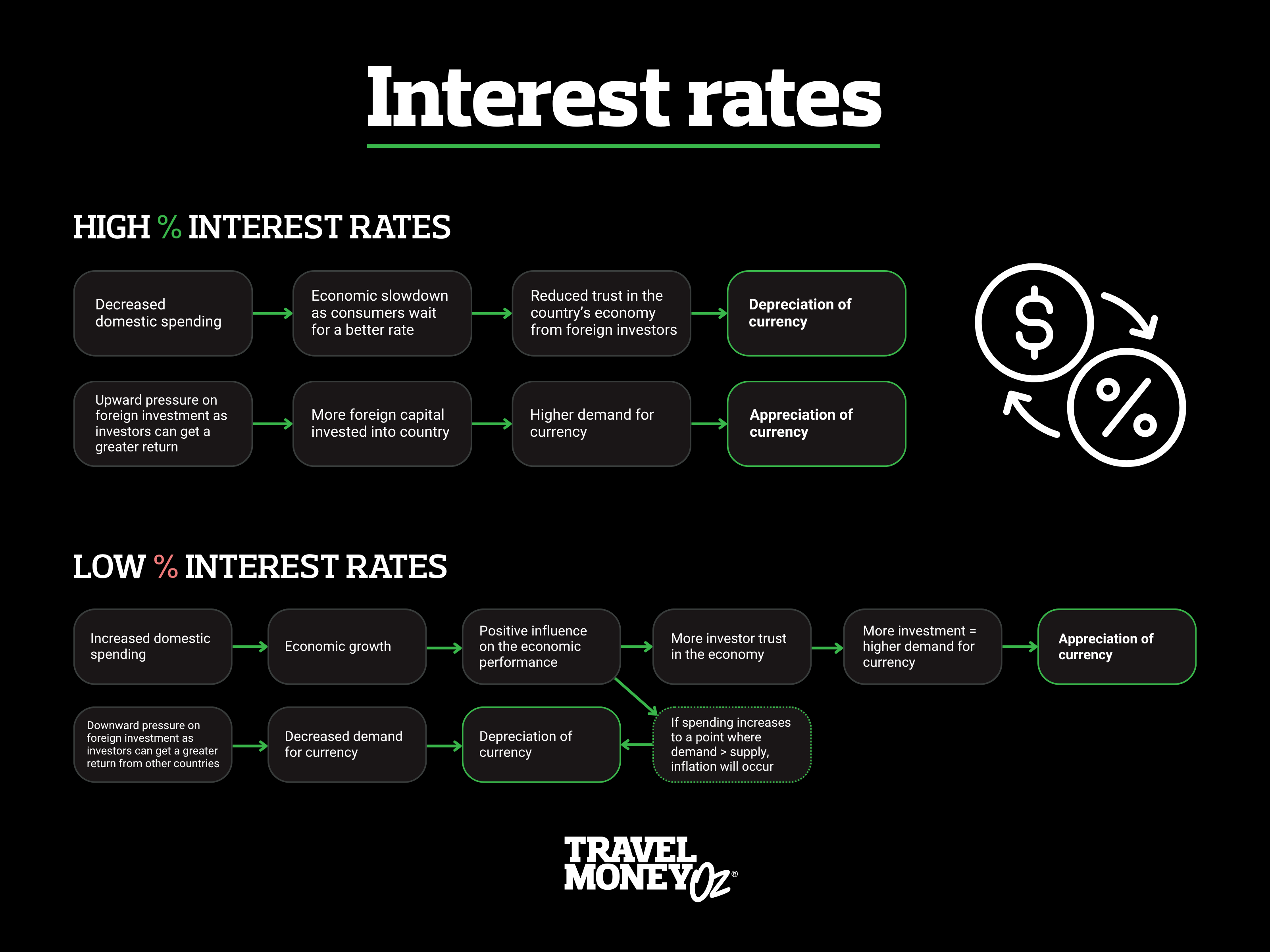
The golden rule: a currency's value is really just supply and demand.
- More trust = more people willing to invest in country = greater demand for currency = appreciation
- Less trust = less foreign capital invested into country = decreased demand for currency = depreciation
The traveller's takeaway
From where we sit in mid-2026, the Australian dollar to Vietnamese dong rate is sitting well compared with a year ago, and the most specific forecast available — MUFG's — expects the dong to weaken a little further, which would push the rate even higher over FY2027. That said, broader commentary on Asian currencies from banks like Westpac leans the other way, and NAB doesn't offer a firm view either way. It's a genuinely split call.
What does that mean for your trip? The rate today is already solid, and there's a real chance it improves further if MUFG's Vietnam-specific view plays out — but given the split opinion, it isn't a rate you should feel you need to hold out on. Locking in some dong at today's levels is a reasonable move, with room to buy more later if the rate keeps drifting your way.
The smart move isn't to gamble on the perfect day. It's to watch the rate, buy in a couple of chunks rather than all at once, and lock in a rate you're happy with when you see it. Set up a currency rate alert and let the watching happen for you, and ask in store about our Rate Move Protection so you're covered if the rate moves in your favour shortly after you buy.
Now go forth and budget those banh mi.
Disclaimer:
*This blog is provided for information only and does not take into consideration your objectives, financial situation or needs. The forecasts referenced here are based on publicly available information published by major banks and financial institutions, and are predictions made by those third parties — they are subject to change and are not guarantees of future performance. All exchange rates, forecasts and conversion examples in this article refer to the mid-market rate (the midpoint between the buy and sell prices, as quoted by banks and financial data providers). This is not the retail rate you receive when you exchange currency. Like all currency providers, Travel Money Oz exchanges at retail rates, which include a margin, so the actual amount of VND you receive for your Australian Dollars will differ from the mid-market figures shown here. You should consider whether the information and suggestions here are appropriate for you. Rates may vary across providers and over time. Figures and "what it buys you" examples are approximations and should be used as a guide only.
* Terms and conditions apply to Rate Move Protection; you can find them here.
FAQ
Will the Australian Dollar get stronger against the Vietnamese Dong in 2027?
What was the highest AUD to VND rate in FY2026?
When is the best time to buy Yen?
Tags
About the Author
.png?h=1080&iar=0&w=1920&t=m16x9)
Amber Dorman
More like this
