.png?h=1200&iar=0&w=1200&t=m1x1)
How the Aussie Dollar fared against the euro in FY2026, and where NAB and Westpac see the AUD to EUR exchange rate heading in FY2027.
Planning a European getaway? Somewhere between shortlisting cities and promising yourself you'll finally learn a few phrases, you've probably checked the AUD to EUR exchange rate and started quietly converting everything into spritzes, train tickets and gelato. It's worth understanding, because the euro has been one of the world's form currencies lately — which makes it a tougher opponent for the Aussie Dollar than the US Dollar has been. Picture two strong currencies pulling against each other, and you've got the gist.
The good news: the rate is refreshingly simple to read. It's a number under one, usually sitting around €0.61, so there are no zeros to count. (Quote it the other way around and you've got the EUR to AUD exchange rate — in mid-2026, one euro buys roughly A$1.64.)
Why sweat the exact rate? Take A$2,000. At today's €0.61 you'd come away with about €1,220. If the Aussie drifts to €0.58, that same A$2,000 is worth only €1,160 — €60 of gelato gone, and you didn't spend a cent. Small moves in the rate add up to real holiday money.
Below, we look at where the Aussie has been against the euro over FY2026, and what the banks are forecasting for FY2027.
First, a quick FY refresher…
When we say FY 2026, we mean the Australian financial year that runs 1 July 2025 to 30 June 2026. FY 2027 is 1 July 2026 to 30 June 2027. So put the calendar year aside just for a moment.
How did the AUD to EUR rate perform in FY2026?
TL;DR: Another comeback year for the Aussie — though against the euro the gains were harder-won, because the euro was strong too.
Where it started (July 2025): The Aussie opened the financial year soft, hovering around €0.55. The euro was riding high as global investors, nervous about the US, parked money in it as an alternative.
The low (August 2025): AUD/EUR bottomed at around €0.552 on 20 August 2025 — the weak point of the year.
The soft patch (late 2025): It stayed subdued in the €0.56 range through the back half of 2025.
The climb (early–mid 2026): Then the Aussie found its legs. The RBA started hiking — taking the cash rate to 4.35% by May 2026, with more flagged — while the European Central Bank stayed cautious. A Middle East flare-up pushed energy prices up and rattled markets. With Australia's economy growing faster than a near-stagnant Europe, the Aussie climbed to a peak of around €0.62 on 13 May 2026, an 18-month-plus high for the cross.
Where it landed (June 2026): It eased back to around €0.61 by mid-June 2026.
The FY2026 scorecard: From roughly €0.55 to around €0.61 — a gain of about 8–10% across the year. Solid, but notice it's a smaller win than the Aussie managed against the US Dollar over the same period, and that's the whole story: the euro itself was strong, so the Aussie had to work harder for every cent.
What is the AUD to EUR forecast for FY2027?
So what does the AUD to EUR exchange rate forecast look like for the year ahead? Here's what NAB and Westpac are tipping.
A heads-up before you read: forecasters disagree, and a forecast is an educated guess rather than a guarantee — so treat it as a guide to plan around, not a certainty. The figures below are each bank's most recently published view, and they get revised over time, so we've linked each one if you want to check the latest.
| Bank/Institution | FY2027 view (AUD to EUR) | Vibe |
| NAB | Rises to approx. €0.61 around Q3 2026, then eases to around €0.58–0.59 | Mild softening |
| Westpac | Sees the euro strengthening (EUR/USD up to approx. 1.21 by mid-2027), pointing to AUD/EUR easing toward around €0.59–0.60 | Mild softening |
Table: Figures are from each bank's own published research — NAB's Global FX Strategist (30 January 2026) and Westpac IQ's May 2026 FX outlook. Both are point-in-time views that get revised, so follow the links for the latest.
What this means in plain English
Notice both banks lean the same way — and it's the opposite of the AUD/USD story. Against the US Dollar, the banks are optimists. Against the euro, they expect the Aussie to give back a little ground: put simply, their forecast for the exchange rate from AUD to EUR is for a gentle drift from around €0.61 today toward €0.58–0.60 across FY2027.
Why the difference? Because the Aussie can be strong and the euro can be stronger at the same time. Both NAB and Westpac expect the euro to keep firming (Westpac sees EUR/USD climbing to about 1.21 by mid-2027), partly because Europe's central banks are leaning towards rate hikes of their own to fight the same energy-driven inflation. When the euro rises faster than the Aussie, the AUD/EUR rate slips, even though the Aussie is doing fine against the greenback.
So, what's it worth to you?
Let's run AUD$2,000 through the range so you can see it in holiday terms.
As NAB and Westpac both expect mild softening, there's a reasonable case that waiting won't do you many favours for a Europe trip — the opposite of the "hold out for a better rate" logic that applies to the US Dollar right now.
| If the rate is… | A$2,000 gets you… | Difference vs 0.70 |
| €0.55 (if it slips to FY2026 lows) | €1,100 | €120 less |
| €0.58 (where the banks see it easing) | €1,160 | €60 less |
| €0.61 (around today) | €1,220 | — |
| €0.62 (FY2026 high, if AUD strength holds) | €1,240 | €20 more |
A quick heads-up: these conversions use the mid-market rate — the midpoint rate quoted by banks and data providers. It's not the retail rate you'll actually get when you buy your travel money, which includes a margin. Treat these figures as a guide to how the market moves, not an exact quote.
How do the banks come up with these numbers?
Banks crunch a huge amount of data, and no single method is bulletproof. But the logic isn't rocket science. For AUD/EUR specifically, a few forces matter most.
The interest-rate gap — on both sides: With AUD/USD, you mostly watch the RBA versus the US Fed. With AUD/EUR, you watch the RBA and the European Central Bank. The RBA hiking helps the Aussie, but if the ECB is also hiking (as it leaned towards in 2026), the euro holds its ground and the cross barely moves.
Relative growth: Money tends to flow to the faster-growing economy. Australia outgrowing a sluggish Eurozone is a tailwind for AUD/EUR; a European recovery would be a headwind.
The euro's "safe-haven-ish" moment: Through 2025, global jitters about the US sent investors into the euro as an alternative. A strong euro for its own reasons keeps a lid on AUD/EUR.
Risk sentiment and commodities: The Aussie is still a "risk-on", commodity-linked currency. Strong global confidence and solid Chinese demand for Australian iron ore and gas support it; fear does the opposite.
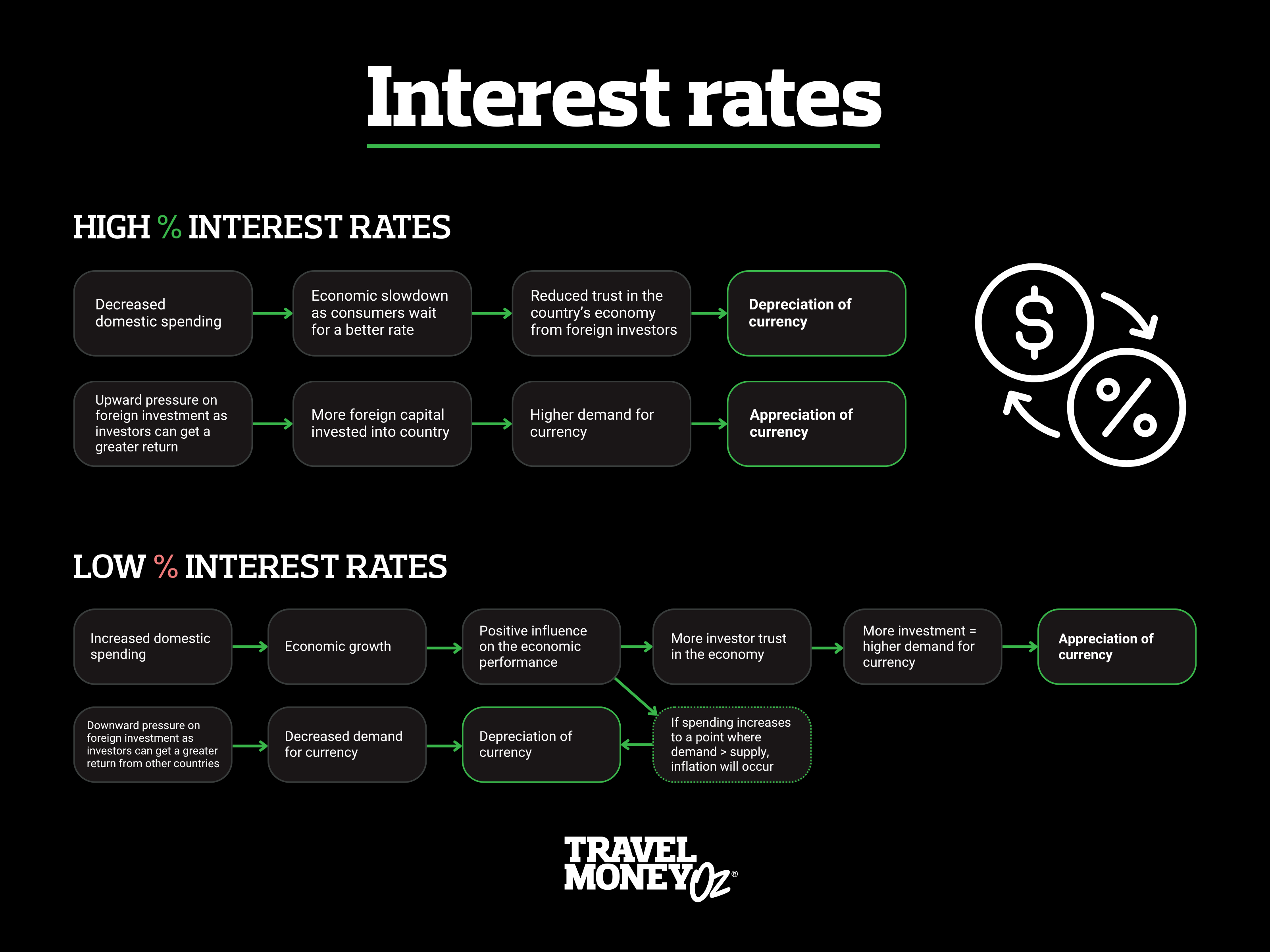
A few definitions to sound clever at trivia
Appreciation: when the Aussie gains value. AUD/EUR going from €0.58 to €0.61 means it has appreciated — more gelato per dollar.
Depreciation: when the Aussie loses value. €0.61 back to €0.58. Less gelato, more maths at the counter.
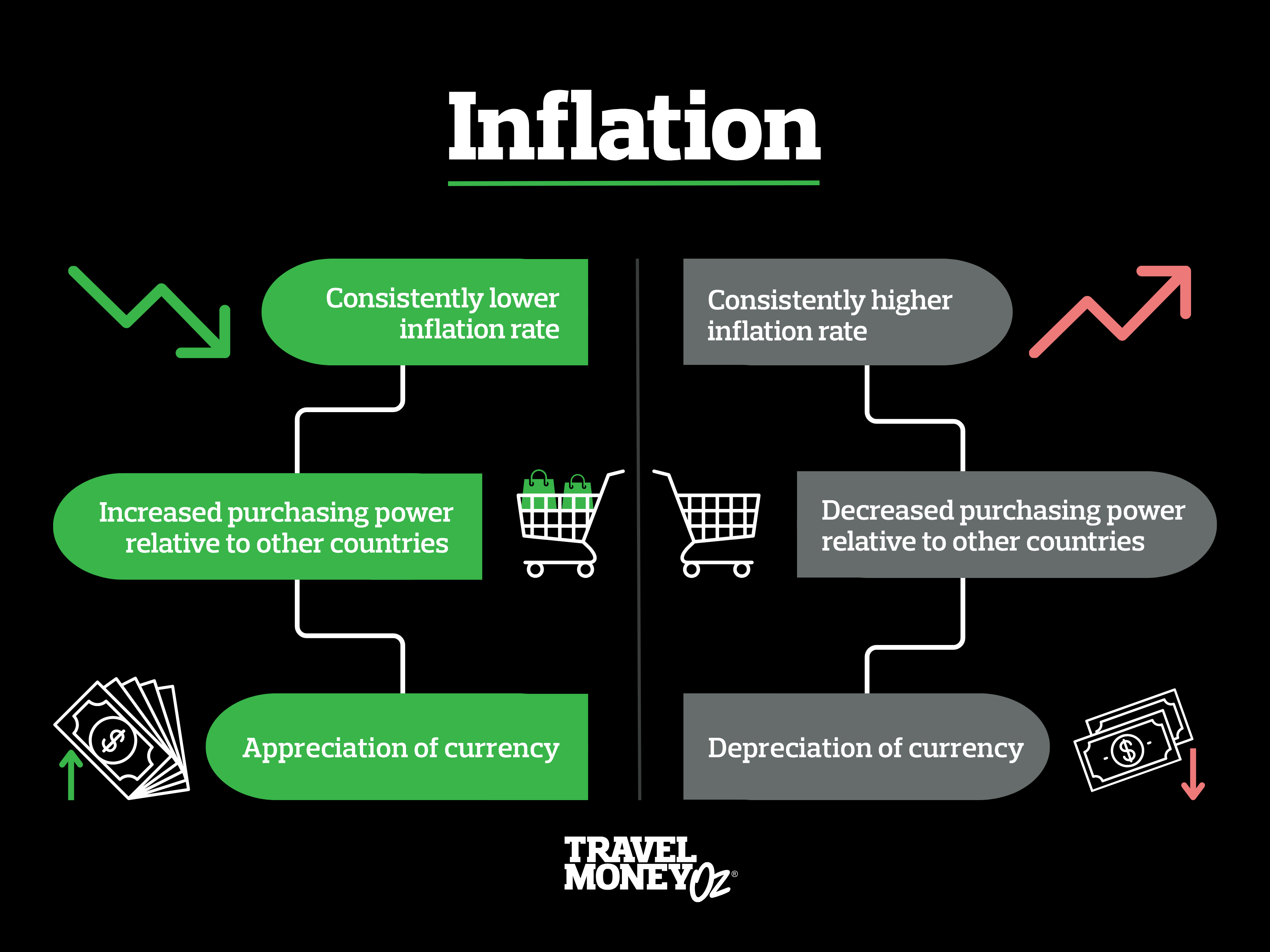
A higher Aussie Dollar means cheaper imports, more expensive exports, and more US Dollars in your travel wallet. A lower Aussie Dollar means the reverse — and a tighter holiday.
The golden rule: a currency's value is really just supply and demand.
- More trust = more people willing to invest in country = greater demand for currency = appreciation
- Less trust = less foreign capital invested into country = decreased demand for currency = depreciation
The traveller's takeaway
From where we sit in mid-2026, NAB and Westpac both lean towards the Aussie easing slightly against the euro in FY2027, into the €0.58–0.60 zone, mainly because they expect the euro to stay strong.
What does that mean for your trip? Unlike a US holiday, there isn't an obvious "wait and it'll get better" case here. If the banks are right, the rate you see today could be about as good as it gets for a while. But forecasts are educated guesses, not guarantees — the RBA, the ECB, energy prices and global drama can all flip the script overnight.
The smart move isn't to gamble on the perfect day. It's to watch the rate, buy in a couple of chunks rather than all at once, and lock in a rate you're happy with when you see it. Set up a currency rate alert and let the watching happen for you and ask in store about our Rate Move Protection so you're covered if the rate moves in your favour shortly after you buy.
Now go forth and budget those croissants.
Disclaimer:
*This blog is provided for information only and does not take into consideration your objectives, financial situation or needs. The forecasts referenced here are based on publicly available information published by major banks and financial institutions, and are predictions made by those third parties — they are subject to change and are not guarantees of future performance. All exchange rates, forecasts and conversion examples in this article refer to the mid-market rate (the midpoint between the buy and sell prices, as quoted by banks and financial data providers). This is not the retail rate you receive when you exchange currency. Like all currency providers, Travel Money Oz exchanges at retail rates, which include a margin, so the actual amount of Euros you receive for your Australian Dollars will differ from the mid-market figures shown here. You should consider whether the information and suggestions here are appropriate for you. Rates may vary across providers and over time. Figures and "what it buys you" examples are approximations and should be used as a guide only.
* Terms and conditions apply to Rate Move Protection; you can find them here.
FAQ
Will the Australian Dollar get stronger against the Vietnamese Dong in 2027?
What was the highest AUD to VND rate in FY2026?
When is the best time to buy Yen?
Tags
About the Author
.png?h=1080&iar=0&w=1920&t=m16x9)
Amber Dorman
More like this

A guide to cherry blossom season Japan
